Blooming
Status: Available
Price: £450
Year: 2024
Oil on canvas
Size: 50x70cm
Unframed
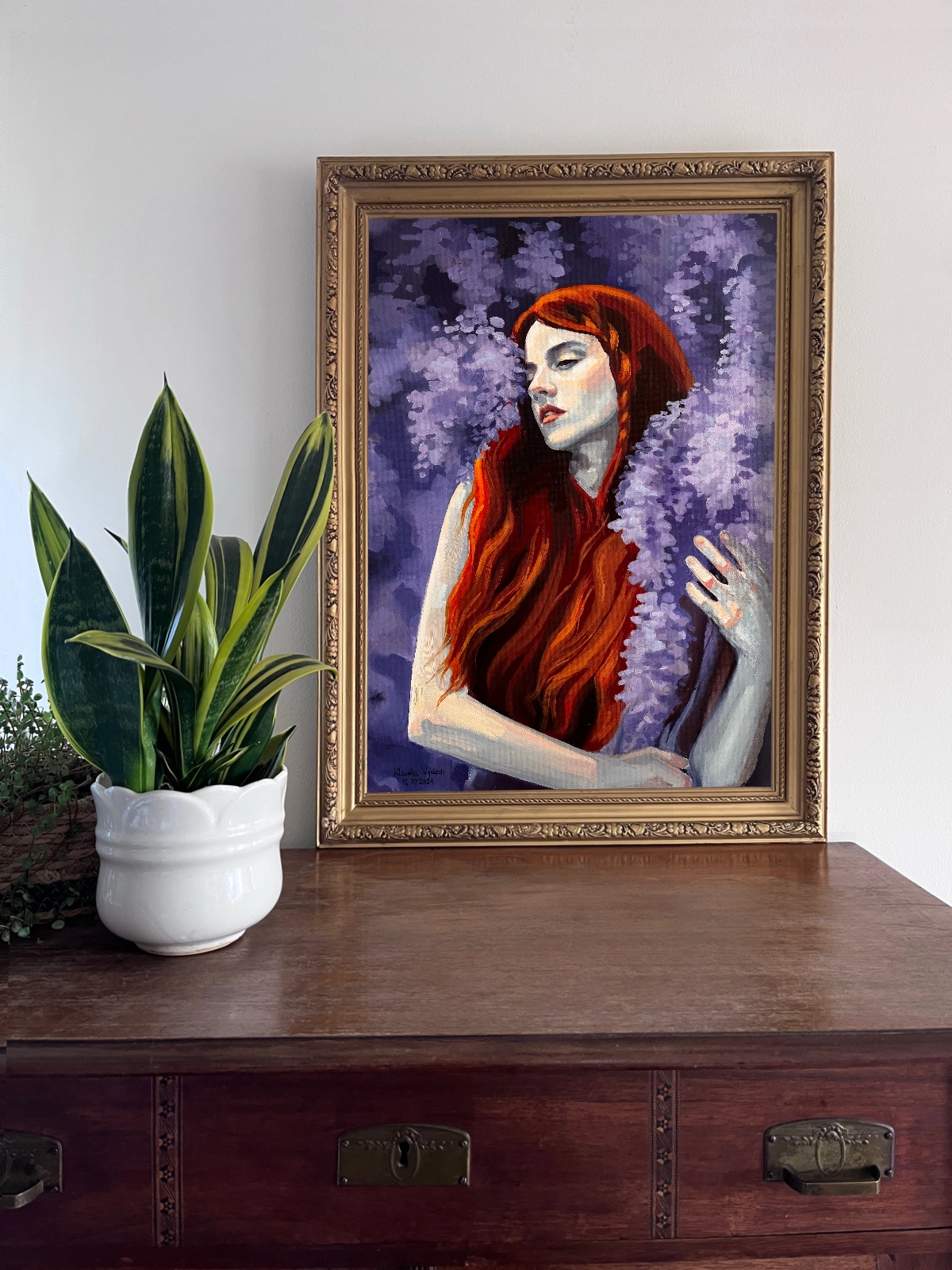
Blooming is a contemporary figurative painting centred on a single female figure enclosed by hanging wisteria. The image is built as a close, vertical composition, with the body set within a dense field of violet flowers. Her red hair falls through the centre, while the pale face, closed eyes and restrained hands give the figure a still, inward presence.
The painting is organised through contrasts of colour temperature and visual weight. Cool violets and blue shadows form the floral space around the body; copper, red and brown tones in the hair bring the figure forward. The skin carries whites, greys, cool blues and warmer notes. The strongest tonal contrasts gather around the face, which becomes the main point of attention through soft edges and colour.
The composition is compact, with forms continuing past the canvas edge. Flowers, arms and hair are cut by the frame, suggesting growth outside the visible image. A triangular structure can be read through the head and the crossed directions of the arms, giving the painting stability while repeated blossoms and flowing hair create movement.
The handling changes across the surface. Broad strokes shape the face and arms, longer marks follow the weight of the hair, and small repeated brushmarks build the wisteria. The flowers overlap the body, compress the space and become part of the figure’s atmosphere. Blooming remains clearly figurative, while close viewing reveals a surface built through colour, rhythm and visible marks.
The painting is organised through contrasts of colour temperature and visual weight. Cool violets and blue shadows form the floral space around the body; copper, red and brown tones in the hair bring the figure forward. The skin carries whites, greys, cool blues and warmer notes. The strongest tonal contrasts gather around the face, which becomes the main point of attention through soft edges and colour.
The composition is compact, with forms continuing past the canvas edge. Flowers, arms and hair are cut by the frame, suggesting growth outside the visible image. A triangular structure can be read through the head and the crossed directions of the arms, giving the painting stability while repeated blossoms and flowing hair create movement.
The handling changes across the surface. Broad strokes shape the face and arms, longer marks follow the weight of the hair, and small repeated brushmarks build the wisteria. The flowers overlap the body, compress the space and become part of the figure’s atmosphere. Blooming remains clearly figurative, while close viewing reveals a surface built through colour, rhythm and visible marks.